Recall the celebrated Black-Scholes equation

Here
 is a time in years; we generally use
  as now;
 is the value of the option;
 is the price of the underlying asset at time ;
 is the volatility — the standard deviation of the asset's returns;
 is the annualized risk-free interest rate, continuously compounded;
 is the annualized (continuous) dividend yield.
The solution of this equation depends on the payoff of the option — the terminal condition. In particular, if at the time of expiration,  , the payoff is given by
  , in other words, the option is a European call option, then the value of the option at time is given by the Black-Scholes formula for the European call:
![{\displaystyle C(S_{t},t)=e^{-r\tau }[F_{t}N(d_{1})-KN(d_{2})]}](https://wikimedia.org/api/rest_v1/media/math/render/svg/010ed9eb4727d514fd5e50ed1e8298940476a36f)
where  is the time to maturity, Failed to parse (MathML with SVG or PNG fallback (recommended for modern browsers and accessibility tools): Invalid response ("Math extension cannot connect to Restbase.") from server "https://wikimedia.org/api/rest_v1/":): {\displaystyle F = S_t e^{(r - q)\tau}}
is the forward price, and
is the time to maturity, Failed to parse (MathML with SVG or PNG fallback (recommended for modern browsers and accessibility tools): Invalid response ("Math extension cannot connect to Restbase.") from server "https://wikimedia.org/api/rest_v1/":): {\displaystyle F = S_t e^{(r - q)\tau}}
is the forward price, and
Failed to parse (MathML with SVG or PNG fallback (recommended for modern browsers and accessibility tools): Invalid response ("Math extension cannot connect to Restbase.") from server "https://wikimedia.org/api/rest_v1/":): {\displaystyle d_1 = \frac{1}{\sigma\sqrt{\tau}} \left[ \ln\left(\frac{S_t}{K}\right) + \left(r - q + \frac{1}{2}\sigma^2\right)\tau \right] }
and

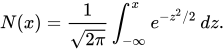
Here we have used  to denote the standard normal cumulative distribution function,
Similarly, if the payoff is given by  , in other words, the option is a European put option, then the value of the option at time is given by the Black-Scholes formula for the European put:
![{\displaystyle P(S_{t},t)=e^{-r\tau }[KN(-d_{2})-F_{t}N(-d_{1})].}](https://wikimedia.org/api/rest_v1/media/math/render/svg/5ada39c7da17ffc228c6d63dee8d7deab5e4d216)
